Polish
Girl's Holocaust Diary Unveiled
By ARON
HELLER
The Associated Press
June 4, 2007.
|
|
|
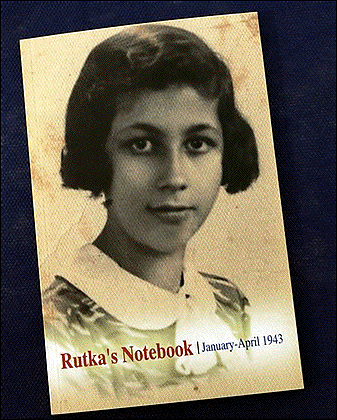
The journal of Rutka
Laskier is seen during a ceremony
presentation at Yad Vashem Holocaust
Museum on June 4, 2007. The diary of a
14-year-old Jewish girl, dubbed the
"Polish Anne Frank," unveiled more than
60 years after the teenager wrote it,
vividly describes the world crumbling
around her as she came of age in a
Jewish ghetto.
(AP
Photo/Sebastian Scheiner)
|

|
JERUSALEM -- The diary of a 14-year-old Jewish girl
dubbed the "Polish Anne Frank" was unveiled on
Monday, chronicling the horrors she witnessed in a
Jewish ghetto _ at one point watching a Nazi soldier
tear a Jewish baby away from his mother and kill him
with his bare hands.
The diary,
written by Rutka Laskier in 1943 shortly before she
was deported to Auschwitz, was released by Israel's
Holocaust museum more than 60 years after she
recorded what is both a daily account of the horrors
of the Holocaust in Bedzin, Poland and a memoir of
the life of a teenager in extraordinary
circumstances.
"The rope around
us is getting tighter and tighter," the teenager wrote in
1943, shortly before she was deported to Auschwitz.
"I'm
turning into an animal waiting to die."
Within a few
months Rutka was dead and, it seemed, her diary
lost. But last year, a Polish friend who had saved
the notebook finally came forth, exposing a riveting
historical document.
"Rutka's
Notebook" . The 60-page memoir includes innocent
adolescent banter, concerns and first loves _
combined with a cold analysis of the fate of
European Jewry.
Some 6 million
Jews were killed by the Nazis during World War II,
after European Jews were herded into ghettos, banned
from most jobs and forced to wear yellow stars to
identify them.
"I simply can't
believe that one day I will be allowed to leave this
house without the yellow star. Or even that this war
will end one day. If this happens I will probably
lose my mind from joy," she wrote on Feb. 5, 1943.
"The little faith
I used to have has been completely shattered. If God
existed, He would have certainly not permitted that
human beings be thrown alive into furnaces, and the
heads of little toddlers be smashed with gun butts
or shoved into sacks and gassed to death."
Reports of the
gassing of Jews, which were not common knowledge in
the West by then, apparently had filtered into the
Bedzin ghetto, which was near Auschwitz, Yad Vashem
experts said.
The following day
she opened her entry with a heated description of
her hatred toward her Nazi tormentors. But then, in
an effortless transition, she described her crush on
a boy named Janek and the anticipation of a first
kiss.
"I think my
womanhood has awoken in me. That means, yesterday
when I was taking a bath and the water stroked my
body, I longed for someone's hands to stroke me,"
she wrote. "I didn't know what it was, I have never
had such sensations until now."
Later that day,
she shifted back to her harsh reality, describing
how she watched as a Nazi soldier tore a Jewish baby
away from his mother and killed him with his bare
hands.
The diary
chronicles Rutka's life from January to April 1943.
She shared it with her friend Stanislawa Sapinska,
who she met after Rutka's family moved into a home
owned by Sapinska's family, which had been
confiscated by the Nazis to be included in the
Bedzin ghetto. Sapinska came to inspect the house
and the girls --one Jewish, one Christian-- formed a
deep bond.
When Rutka feared
she would not survive, she told her friend about the
diary. Sapinska offered to hide it in the basement
under the floorboards. After the war, she returned
to reclaim it.
"She wanted me to
save the diary," Sapinska, now in her 80s, recalled
Monday. "She said 'I don't know if I will survive,
but I want the diary to live on, so that everyone
will know what happened to the Jews.'"
Sapinska stashed
the diary in her home library for more than 60
years. She said it was a precious memento and
thought it to be too private to share with others.
Only at the behest of her young nephew did she agree
to hand it over last year.
"He convinced me
that it was an important historical artifact," she
said in Polish.
In 1943, Rutka
was the same age as Anne Frank, the Dutch teenager
whose Holocaust diary has become one of the most
widely read books in the world. Yad Vashem said
Rutka's newly discovered diary was authenticated by
experts and Holocaust survivors.
Rutka's father,
Yaakov, was the family's only survivor. He died in
1986. But unlike Anne Frank's father, he kept his
painful past inside. After the war, he moved to
Israel, where he started a new family. His Israeli
daughter, Zahava Sherz, said her father never spoke
of his other children, and the diary introduced her
to the long-lost family she never knew.
"I was struck by
this deep connection to Rutka," said Sherz, 57. "I
was an only child, and now I suddenly have an older
sister. This black hole was suddenly filled, and I
immediately fell in love with her."
"I have a feeling
that I am writing for the last time," Rutka wrote on
Feb. 20, 1943, as Nazi soldiers began gathering Jews
outside her home for deportation.
"I wish it would
end already! This torment; this is hell. I try to
escape from these thoughts of the next day, but they
keep haunting me like nagging flies. If only I could
say, it's over, you only die once ... but I can't,
because despite all these atrocities, I want to
live, and wait for the following day."
However, Rutka
would write again. Her last entry was dated April
24, 1943, and her last written words were: "I'm very
bored. The entire day I'm walking around the room. I
have nothing to do."
In August, she
and her family were sent to Auschwitz, where she is
believed to have been killed upon arrival.